Building code

The Trouble with Driveways

The forest where Tiny House Ontario sits, has had very little human intervention.  I had a few trees go missing on the South East ridge in 2010 (a former neighbour cut them down, to burn for fire wood; they were not his to take).  This was all the damage done to the land when I considered my Tiny House build.

I would like to live there but I also do not want to harm the forest.  I did not want to cut any trees at all, but reasonably, I needed to have a route in.  An entry just makes life so much easier, not just for my own purposes of living, but for the cement delivery, lumber delivery and so on, I required a road.

I did not go about this all helter-skelter and without a good deal of forethought.  In order to put in my driveway I chose the point of least damage through; I made a lot of effort to keep from taking any trees over 3 inches in diameter, and I also did not want to cut a single shag bark hickory.  These hickory trees are rare and protected so it is not only illegal to cut them, it is unethical.  I managed to keep every hickory, but there were a few maples that had to go, so I could have an entry point.  My friends John and Leo cleared the lane all the way back to the ridge, but got four pick up trucks of firewood from a 600 foot long and 8 foot wide lane way, which is a very small and reasonable loss.  They did not clear cut, certainly, but did cut a swath out of the woods.   About half the wood they got came from a large dead maple which wanted for reuse, and thus put the driveway right over it’s old trunk.  Aside from the large dead one, I believe that there were about 20 trees that were larger than 3 inches were cut, but only two were larger than 8 inches.

There were no trees cut down in order to make space for Tiny House Ontario.  A spot was chosen where there was a natural clearing.

It was not just trees and that had to go.  As I mentioned in an earlier post, a lot of what was removed to get through was a swipe through the “prickly pear” (which I think is a sort of a fruitless rubus cane).  There were also a lot of small saplings and trees that were less than 3 inches in diameter, these were sacrificed.  I also covered a lot of leeks, wild lilies, mayflowers, a few trilliums, and a small patch of wild ginseng too.  What I mean is that you cannot buy land which has a low yielding potential for farming, to build on and expect that you will not damage any of the natural features in the process.  It is a pity but it had to be done, if I am to actually enjoy the use of this land.

A nice side effect of the little bit of clearing, is that the new openings will allow two more benefits for me.  Both are because now there is light coming in.  I will be able to add a vegetable garden and solar panels.

While I did my best to be as conscientious as possible, I absolutely caused damage to the forest.   Here is what I did to get it in step by step, with a small slide show for you to see the process.

  • I picked the route of least resistance.
  • I made a path with some bright yellow string.
  • Permit was applied for and attained.
  • John and Leo came in and cut everything within 10 feet of the line (except one hickory which is 8 feet in and makes a narrow spot in the driveway).  The photo of me with my chainsaw is taken on a former property when I lost a half dozen huge cedars to a flood.
  • Myself, and my husband cleared the “prickly pear”.
  • Myself, and a few lads cleaned the sticks up with a chipper.
  • The planned driveway and tiny house location were clear to take some (minimal excavation and) gravel.
  • The gravel was brought in load, by load, and flattened by my cousin Kenny’s tractor and accessories.
  • Tiny House Ontario hole was dug and filled with stone, cement was brought in and laid and then it was built.
  • Several final loads of gravel were brought in right up to the Tiny House that I tamped down.
  • The culvert was installed by the road, but not accepted by the county (twice so far), so I do not have an entry permit as of yet.

This slideshow requires JavaScript.

Categories: Building code, Environmentalism, Forest, Nature, Off Grid, Simple living, Tiny House Ontario | 2 Comments

The cloth porch is still standing

I have written before about the cloth porch.  A few dollars worth of deeply discounted fabric, some left over boards and two boxes of staples as well as a screen door is what it is comprised of.  While I was building it, then banging in the staples, I resigned myself to having to redo the cloth covering annually because I assumed that the thin, semitransparent, fabric roof would never stand the weight of the winter snow on it.  We have had a couple of pretty good snow falls now, so I thought for sure, when I arrived to check in, it would be down.  It is late January now, and to my surprise the cloth porch is still standing.

I know! I know! It is not the most beautiful addition that was ever put on a Tiny House but if you have ever been to Ontario in the spring (and summer) you will know that if the black flies don’t get you in the spring, then deer flies, horse flies, ticks and mosquitoes surely will get what is left of you before you freeze to death in our winters.

I am starting to believe that buying and installing new cloth is one job I may not have to do in the spring!  Time will tell.

Categories: Building code, Cloth Porch, Environmentalism, Materialism, Off Grid, Ontario, Sustainable living, Time, Tiny house, Tiny House Ontario, Winter | Leave a comment

Building Code Ontario and Tiny House Ontario

OK you caught me, I am an artist and writer and some things simply don’t interest me that much, or hardly at all.  Also I like to think outside of the box, which is probably what lead me to the Tiny House Movement to begin with.

For example, my take on it is that the Ontario Building Code, is not very different from any other rule book.  Kinda boring.  Started originally with good intentions, like keeping people from burning to death, then it got signed on to by ever more groups, added onto over and over and over. Intuitiveness and sensible stuff gets shoved aside somewhere along the line and this rule book becomes as stagnant as the water in an old tire.  Inevitably, to make any changes to this or any other rule book you have to fight like a warrior and often times with no hope.

If you clicked on the OBC link above, or if you are one of those sorts who read the rules, then you will know that the OBC book is absolutely HUGE.  I have not read it.  GASP!  What I have done is that I have consulted with a few builder friends and relatives because chatting and planning are more fun and interesting for me.  I let the people in the know tell me what I need to.

There were some steadfast things that I learned, by osmosis and through these chats, and when I was pretty sure I knew what I was talking about was pretty firm, then I called the Township office and spoke to the building inspector in February of 2011.  I fortunately reached this inspector directly.  I gave the inspector my address and name and began to speak.

I told the inspector that I don’t live close and that I wanted to build a 108 foot structure (on my land) for me and my dogs to stay in when I visited home.  I also said that I might want to use this when and if I eventually build a home there.  I was told that I can do that.

I then told the inspector that I wanted to do it in straw bale and the inspector said that 108 square feet is the maximum for the exterior measure (new news), so if I build with straw I would have only about 40 square feet left on the inside.  I asked the inspector if there were any exceptions, I was told no exceptions.  This is when I knew that I would have to use 2×4’s so that I would have some interior space.  Oh well.

I told the inspector that I was planning on building a place which was insulated, 15 feet high and with lots of windows.  The inspector said that the details like this do not matter as long as it is up to code in terms of safety and that it could not be over 15.5 feet.  Good to know.

Thus Tiny House Ontario is a stick built house on a cement pad with a sort of verbal clearance from the inspector there.  As far as I know this inspector has not been in but the Road’s inspector has been in and seen Tiny House Ontario because this inspector has to approve (hopefully next time around) my damn culvert.  Two unsuccessful visits to date.  UGH!

A recent query on here makes me worried that someone in a government suit will pull in to my land and insist that I tear down Tiny House Ontario.  I truly hope that this is not the case.  With nothing in writing I guess you are always vulnerable.  Still I think that I did everything that I am supposed to.

Categories: Building code, Environmentalism, Materialism, Rules, Sustainable living, Tiny house, Tiny House Ontario | Tags: | 69 Comments

Great Uncle Frank’s Tiny House

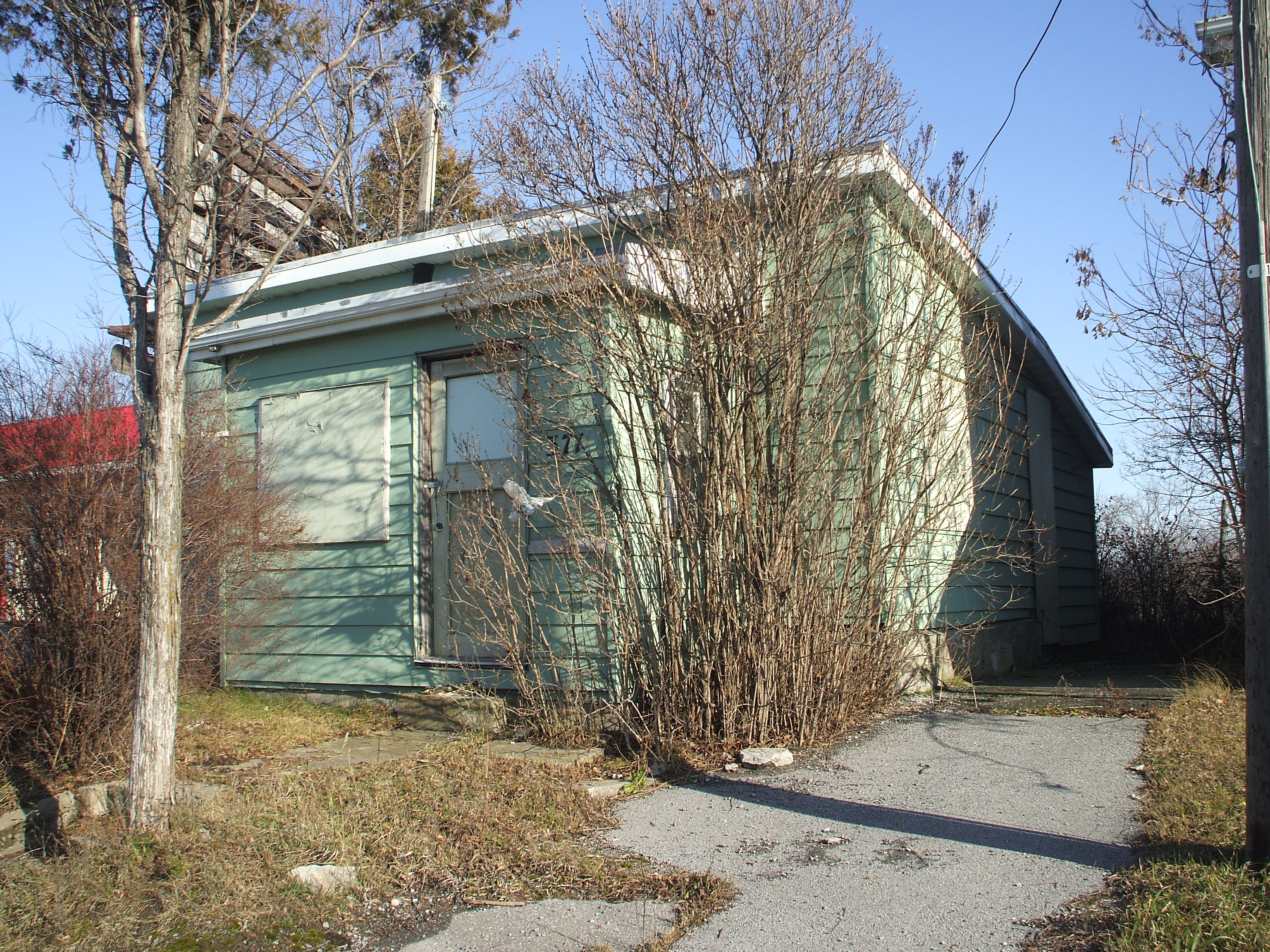
I went to Tiny House Ontario over the weekend and drove in to see my grandma Violet Rickards.  Grandma is approaching 90 and recently, feeling slowed down and tired.  On the route in, I took Rideau Street, ironically, where grandma’s brother, Frank Compton (Punky) lived in his Tiny House when I was a young girl.  Great Uncle Frank worked on the big ships and due to this work, he grew accustomed to small spaces and when he finally hit land he never changed that way of living.  He bought a Tiny House and lived there until the end of his life.

When I was young, I loved to visit Great Uncle Frank.  He allowed me to open the cupboards and look around.  Not only that, he encouraged me to explore.  He would say “there is a treat somewhere, and you will have to find it”.   Or, go lift up the latch in the closet and see what is down in the cellar.  In retrospect I suppose that this allowed him to have a grown up visit at his Tiny House, but when I was a kid, I did not see it like that.  What I saw was that I was allowed to to exactly what I wanted to do when I visited him.

This Tiny House at 371 Rideau Street in Kingston Ontario, sits empty.  It was never what one would call a fancy house but all a single person needs to live comfortably.  It had a quirky but functional bathroom, a decent sized kitchen, a small bedroom with a closet (where the basement entry latch was in the floor), and a little sitting room too.  The coolest thing about this tiny house is that it also has a really good sized shed and a back yard that is a great size and which overlooks the Rideau Canal, he kept his horse there.  It is a great, conveniently located, spot except that the street is somewhat busy and there is an industrial welder who is housed across.   Still, it sickens me to see this Tiny House sit empty in a world where so many people are homeless.  No reason why this could not be tidied up again and made into a house that someone could call home.  When I was a young single mom, I would have loved to have had this tiny house to live in, still would!

Today, when kids in the neighbourhood of Tiny House Ontario come to visit, and they do come… I do just as Great Uncle Frank did.  I tell them to look around, open things up, go upstairs and see what I have done up there.  I encourage them to look for hidden treats and also to tell me about themselves.  I very rarely have grown ups there when they come, so I don’t really care about adult conversations, and maybe Great Uncle Frank did not either.  Perhaps, just perhaps, it is just as it should be and he was truly Great Uncle Frank, just as he was called.  

Categories: Building code, Materialism, Rules, Stuff, Sustainable living, Tiny house | 1 Comment